I've been kicking around, for awhile now, this idea of the Big 5. That managing our health and happiness requires regular and dedicated attention to 5 key areas:
Nutrition
Movement
Awareness of key values and motivators,
Daily consideration of time stewardship, and
Connection
The Big 5 Self-Assessment, available for free download here , allows the user to consider one's awareness of these domains and commitment to taking good care of his or her physical and mental health. I'm hoping for feedback as I continue to sketch this out and consider clinical applications.
Showing posts with label happiness. Show all posts
Showing posts with label happiness. Show all posts
Saturday, January 10, 2009

Tuesday, January 6, 2009
Schadenfreude and "Revolutionary Road"
In a recent New York Times editorial, Judith Warner suggests that our appetite for dour representations of 1950s and 1960s domestic life (e.g., the Sam Mendes adaptation of Richard Yates' Revolutionary Road ) relates to a strange envy of that era. A doutbful and jealous curiosity about "how Dad managed to come home at 5 p.m. to read the paper or watch TV while Mom fixed dinner and bathed the kids. How Mom turned up at school, every day, unrumpled, coiffed, unflappable. And more to the point: how they managed to afford the lives that they led, on one salary, without hocking their homes to pay for college, without worrying about being bankrupted by medical bills."
) relates to a strange envy of that era. A doutbful and jealous curiosity about "how Dad managed to come home at 5 p.m. to read the paper or watch TV while Mom fixed dinner and bathed the kids. How Mom turned up at school, every day, unrumpled, coiffed, unflappable. And more to the point: how they managed to afford the lives that they led, on one salary, without hocking their homes to pay for college, without worrying about being bankrupted by medical bills." Books and movies which portrays exemplars of this generations as "frivolous, almost simple-minded depressives" and "(assign) them drunken, cheating, no-good mates" give the viewer the satisfaction of come-uppance.
A strange type of happiness is schadenfreude - taking pleasure in others' misfortunes. Like a lot of not-so-nice human behavior, schadenfreude may be rooted in our genetic history.
A 2007 study by Shamay-Tsoory and colleagues, published in the journal Brain, suggests that the ventromedial prefrontal cortex may play an important role in the experience of gloating and envy. The ability to process these emotions may depend upon the cognitive ability to put oneself in another's shoes, to recognize that others have thoughts and feelings which differ from one's own. These are central aspects of the "theory of mind" , referring to a set of cognitive capacities which may be weaker among, for example, individuals with autistic spectrum disorders.
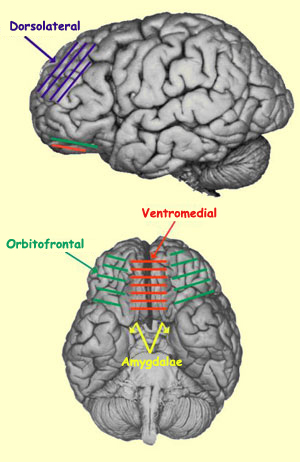
In a way, then, our capacity for schadenfreude is the "flip side" of our brains' capacity for empathy.
And we might not always be the one observing the suffering....recognizing that we may play a role in other people's experience of schadenfreude, the cast of Avenue Q remind us that "The world needs people like you and me who've been knocked around by fate. 'Cause when people see us, they don't want to be us, and that makes them feel great!"
Monday, December 29, 2008
A (slightly) new twist on an old maxim
In his 1954 treatise on the topic of happiness,The Real Enjoyment of Living , Rabbi Hyman Judah Schachtel, suggested that "happiness is not having what you want, but wanting what you have." An April 2008 Psychological Science article describes research by Jeff Larsen and Amie McKibban into just that proposition. Undergraduates were asked whether they owned each of a list of 52 items, and then asked the extent to which they wanted those items. The relationships were then examined between these ratings and variables such as gratitude and happiness. The researchers found that subjects can become accustomed to their material possessions and come to derive little pleasure from them. On the other hand, Larsen & McKibban found that sustained gratitude and appreciation for prized belongings is associated with happiness. They conclude that "happiness is both wanting what you have and having what you want."
, Rabbi Hyman Judah Schachtel, suggested that "happiness is not having what you want, but wanting what you have." An April 2008 Psychological Science article describes research by Jeff Larsen and Amie McKibban into just that proposition. Undergraduates were asked whether they owned each of a list of 52 items, and then asked the extent to which they wanted those items. The relationships were then examined between these ratings and variables such as gratitude and happiness. The researchers found that subjects can become accustomed to their material possessions and come to derive little pleasure from them. On the other hand, Larsen & McKibban found that sustained gratitude and appreciation for prized belongings is associated with happiness. They conclude that "happiness is both wanting what you have and having what you want."
Sunday, December 28, 2008
A bit late for your holiday shopping consideration...
One of 2008's most discussed articles in positive psychology circles was Dunn, Aknin, & Norton's "Spending money on others promotes happiness" published in the journal Science. Brieflly, the authors examined the relationship between happiness and spending, and focused on differences between spending on self versus spending on others.
The article described three studies. One was a national survey. Another was a study of "windfall spending" (employees of a Boston medical supply company were given bonuses; spending was tracked and relationships to reported happiness were observed). The final study involved subjects randomly assigned to spend money on either themselves or others.
In this third study, the authors reported that "very minor alterations in spending allocations....may be sufficient to produce non-trivial gains in happiness on a given day."
Here's a .pdf of the article: http://research.chicagogsb.edu/cdr/docs/spendingmoney-norton.pdf
And here's an article about the study in the Boston Globe: http://www.boston.com/business/personalfinance/articles/2008/03/21/money_makes_you_happy___if_you_spend_it_on_others/
The article described three studies. One was a national survey. Another was a study of "windfall spending" (employees of a Boston medical supply company were given bonuses; spending was tracked and relationships to reported happiness were observed). The final study involved subjects randomly assigned to spend money on either themselves or others.
In this third study, the authors reported that "very minor alterations in spending allocations....may be sufficient to produce non-trivial gains in happiness on a given day."
Here's a .pdf of the article: http://research.chicagogsb.edu/cdr/docs/spendingmoney-norton.pdf
And here's an article about the study in the Boston Globe: http://www.boston.com/business/personalfinance/articles/2008/03/21/money_makes_you_happy___if_you_spend_it_on_others/
Friday, December 26, 2008
Intro
After decades of focus on pathology, psychology has just recently begun to take seriously the factors that promote human happiness and resilience. Values, friendship – these have not been on the table for serious discussion. The emerging field of positive psychology, however, is taking up the challenge. Determining what makes some people happier than others, and what makes each of us happier at some points than at others.
And there is plenty of sloppy thinking on the topic. My purpose with this blog is offering a review of the best of the scientific literature on happiness. What are the known brain-behavior relationships governing motivation and happiness, and how do concepts such as values map on to these relationships?
I’ve been bouncing these ideas off colleagues and friends for years, and now I hope to interact with you. You’re someone who is interested in brain-based happiness…and I’m interested in that. Speak to me.
And there is plenty of sloppy thinking on the topic. My purpose with this blog is offering a review of the best of the scientific literature on happiness. What are the known brain-behavior relationships governing motivation and happiness, and how do concepts such as values map on to these relationships?
I’ve been bouncing these ideas off colleagues and friends for years, and now I hope to interact with you. You’re someone who is interested in brain-based happiness…and I’m interested in that. Speak to me.
Subscribe to:
Posts (Atom)